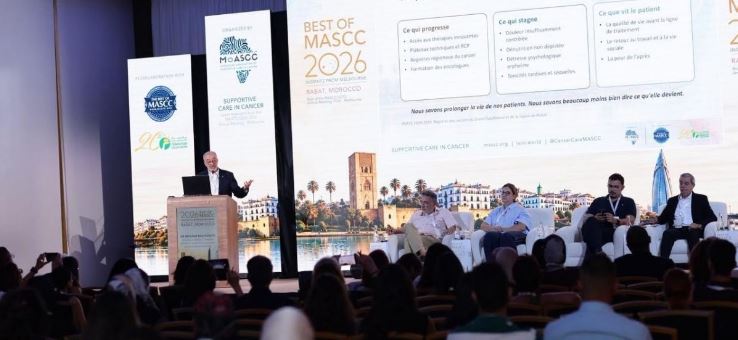
Rabat brought together cancer care specialists on September 26 for the first “Best of MASCC” meeting ever held in Africa, creating a new platform for sharing advances in supportive cancer care across the region.
Organized by the Moroccan Association of Supportive Care in Cancer (MOASCC), in partnership with the Lalla Salma Foundation for Cancer Prevention and Treatment and the Multinational Association of Supportive Care in Cancer (MASCC), the event focused on research presented earlier this year at the MASCC/ISOO international conference in Melbourne.
The meeting provided Moroccan and international specialists with an opportunity to examine recent evidence and discuss how supportive care can be integrated more effectively into cancer treatment pathways.
Among the key topics were inequalities in access to supportive care and evidence-based integrative oncology. Experts also addressed the management of toxicities associated with newer cancer therapies, including treatment-related cardiac complications.
The programme extended beyond medical complications to include psychosocial support, adapted physical activity and assistance for caregivers. These areas are increasingly considered part of a broader approach to maintaining patients’ well-being throughout treatment.
The Lalla Salma Foundation presented its approach to supportive cancer care through Dr. Rachid Bekkali, while MOASCC highlighted the need to give supportive care a stronger place within cancer services in Morocco.
Supportive care is designed to address the physical, psychological and social consequences of cancer and its treatments throughout the patient journey. Its role can become particularly important as advances in oncology allow patients to live longer with the disease.
According to Dr. Mounir Bachouchi, president of MOASCC, improvements in cancer therapies are changing patients’ needs as survival increases. Supportive care can help patients better tolerate and adhere to treatment while contributing to quality of life and maintaining autonomy.
The Rabat meeting therefore served as a bridge between international scientific developments and clinical practice in Morocco and Africa, bringing the latest discussions from Melbourne closer to healthcare professionals in the region.