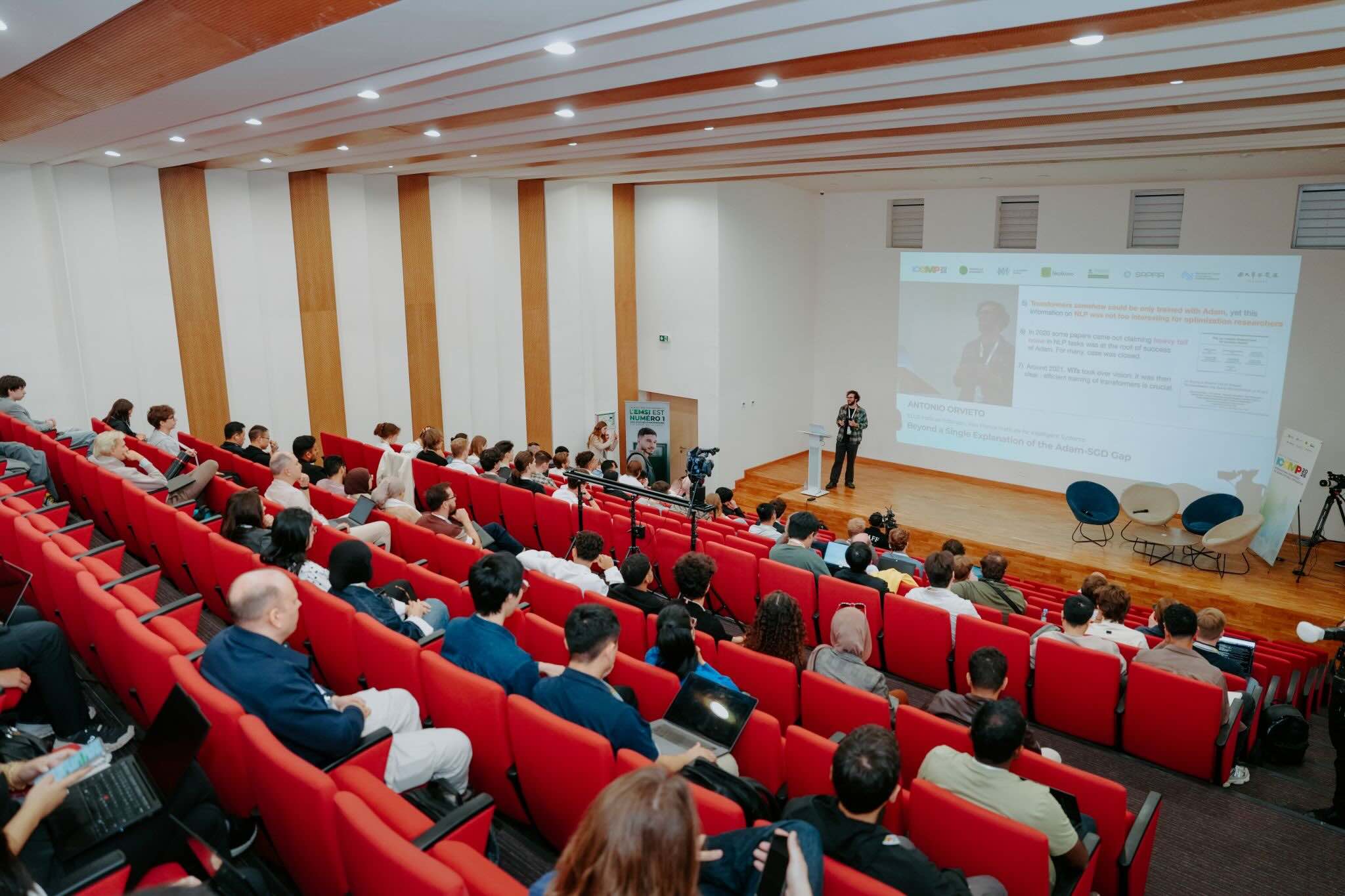
Casablanca brought together some of the world’s leading artificial intelligence researchers from November 3 to 6, as Morocco hosted the third edition of the International Conference on Computational Optimization (ICOMP 2026). For the first time, the event was held on African soil, marking a new milestone for the country’s ambitions in scientific research and advanced technologies.
The conference was hosted by the Moroccan School of Engineering Sciences (EMSI), in partnership with Innopolis University in Russia and Mohamed Bin Zayed University of Artificial Intelligence (MBZUAI) in Abu Dhabi. Its scientific programme focused on computational optimization, a field that plays a central role in improving the performance and efficiency of artificial intelligence systems.
The event attracted internationally recognized academics and specialists. Among the announced speakers were Michael Jordan, professor at the University of California, Berkeley, and a leading figure in statistical learning and AI. Researchers from Mistral AI, the Max Planck Institute for Intelligent Systems, the University of Zurich, Grenoble Alpes University, the Australian National University and King Abdullah University of Science and Technology (KAUST) also featured in the programme.
Their presence placed Casablanca at the centre of discussions on the mathematical and algorithmic foundations of next-generation AI technologies.
For Morocco, hosting ICOMP represents an opportunity to strengthen connections between local universities and international research institutions. It also highlights the growing role of engineering schools in developing scientific partnerships beyond traditional academic exchanges.
The conference addressed several challenges facing the AI industry. As artificial intelligence models become increasingly complex, researchers are seeking ways to reduce computing requirements while maintaining performance. Topics included more efficient model training and inference, neural network architectures, model compression and large-scale optimization algorithms.
These advances have practical implications for businesses and public institutions. Reducing the computing resources required to operate AI systems could lower deployment costs and make advanced technologies more accessible, particularly in environments with limited infrastructure.
EMSI’s Multidisciplinary Research and Innovation Laboratory (LPRI), led by Dr. Mohamed Tabaa, played a central role in organizing the event. The laboratory’s involvement reflects the school’s efforts to connect engineering education with fundamental research and technological innovation.
The programme also included ASCOMP 2026, a scientific school designed for master’s students, doctoral candidates and young researchers. Participants had the opportunity to attend specialized courses, exchange ideas with international experts and present their own research.
This educational component gave Moroccan students direct access to international scientific expertise without having to travel abroad. It also created opportunities to establish academic contacts and explore future research collaborations.
After previous editions in Innopolis in 2024 and Abu Dhabi in 2025, the choice of Casablanca for ICOMP 2026 reflects the conference’s expanding international reach. It also brings renewed attention to Morocco’s scientific ecosystem at a time when artificial intelligence is becoming a strategic priority for economies worldwide.