HEM International University has officially begun its activities in Casablanca for the 2026-2027 academic year, following its authorization to operate as a university. The institution, a member of LCI Education, presented its new academic model and development ambitions during an official launch event attended by Casablanca-Settat Regional Council President Abdellatif Maâzouz.
The transition from HEM to university status marks a significant expansion for the institution, which aims to establish itself as a leading higher education player in Morocco through academic excellence, international exposure and stronger links with the business community.
The university is built around a partnership between LCI Education, CDG Invest, the investment arm of CDG Group, and Averroes Holding. Its governance structure includes a general management team, a dean and a strategic and scientific council bringing together figures from academia, business and public institutions.
For Younes Slaoui, chairman of the board of HEM International University, the move to university status opens up new ambitions for the institution. He stressed that the project is intended not simply to bring several schools under one structure, but also to contribute to the transformation of Morocco’s higher education system and respond to changing skills and professions.
Human capital is at the heart of this approach. The university aims to help address the needs of Morocco’s economy by preparing graduates for evolving professional requirements while supporting the country’s growing international economic ambitions.
Its international dimension is reinforced by its membership in LCI Education, an international education group operating across five continents and bringing together more than 20,000 students.
The academic offering will initially bring together several components, including the Business School in Casablanca and Rabat, the Averroes Engineering School, a Faculty of Law and Executive Education. According to Bouchra By, director general of HEM International University, the programmes have been designed with the labour market in mind, with employability and professional readiness placed at the centre of the educational model.
Work-study programmes will play an important role in this strategy. The university intends to involve partner companies in the development of academic programmes, allowing training to remain closely aligned with professional realities and giving students greater exposure to the workplace.
The institution also plans to expand international student mobility, academic partnerships and double-degree programmes. This strategy builds on HEM’s existing international collaborations, including its joint MBA with Université Paris Dauphine-PSL and IAE Paris-Sorbonne. The partnership is celebrating 25 years of cooperation and has supported more than 800 executives, business leaders and entrepreneurs in Morocco and Africa.
Research is another pillar of the new university. Its Research Centre, chaired by Driss Ksikes, is expected to develop and disseminate research on Morocco’s and Africa’s economic and social transformations while encouraging dialogue between academia, businesses, institutions and society.
The university’s broader ambition is to train the talent required by Morocco and Africa while contributing to innovation, research and knowledge development and strengthening the Kingdom’s academic profile internationally.
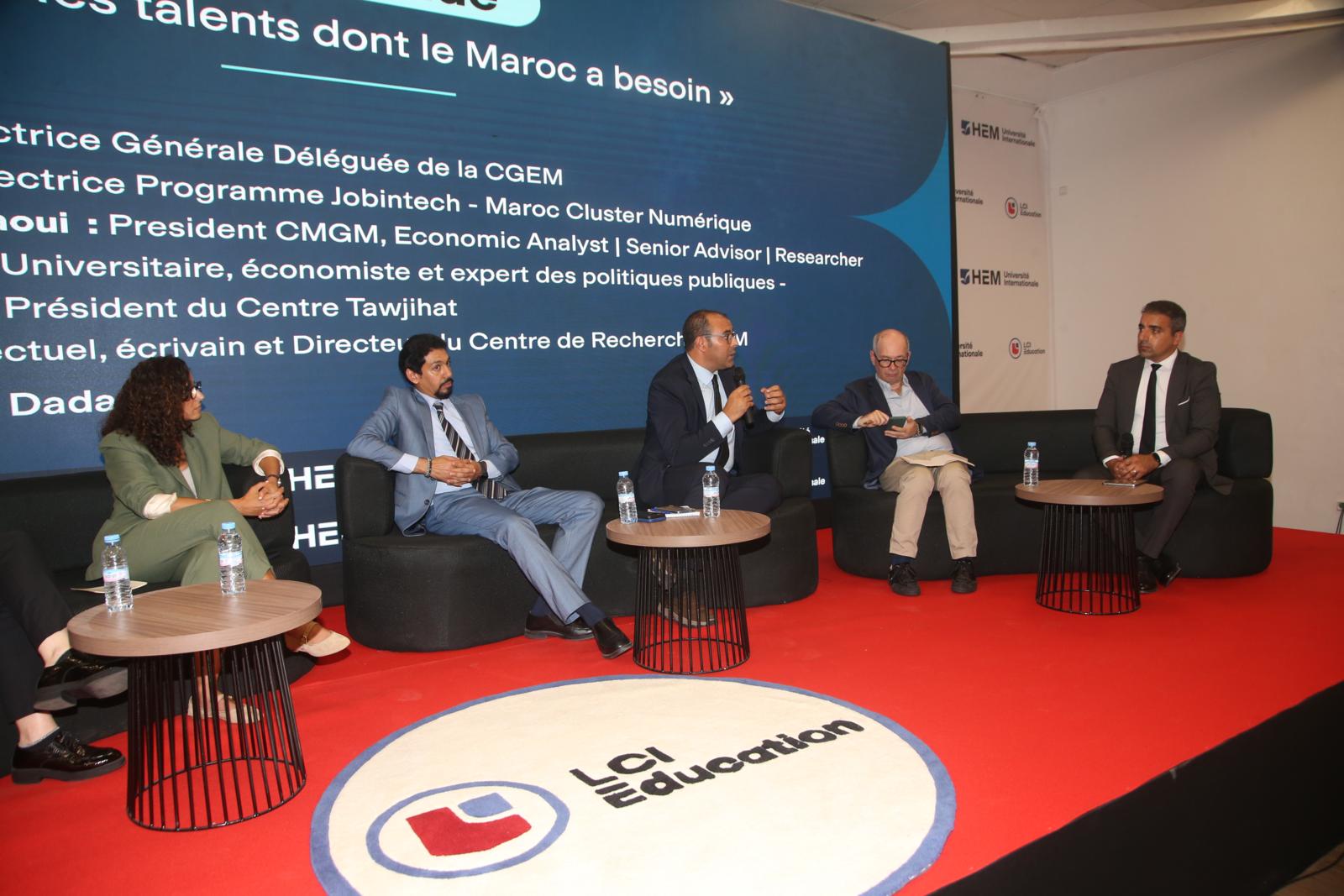
The launch event concluded with a panel discussion entitled “Training the talent Morocco needs”. Professionals examined issues shaping the national economy, including economic sovereignty, value creation across regions, structural economic transformations and the need to align higher education more closely with labour-market requirements.