
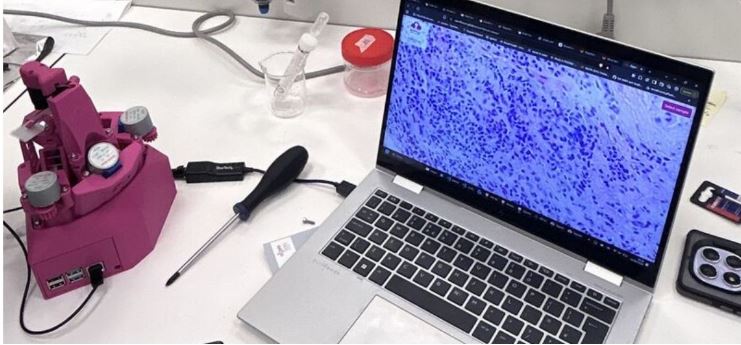
Mohammed VI Polytechnic University (UM6P) is exploring new approaches to medical technology through open-source hardware, artificial intelligence and digital health. The university recently hosted a two-day workshop dedicated to the development and certification of emerging MedTech solutions.
Organized in partnership with the Arab-German Young Academy of Sciences and Humanities (AGYA), the “Open Healthware, AI & MedTech Certification” workshop combined expert presentations with practical sessions.
Participants examined how open-source technologies could be applied to healthcare while also discussing the regulatory requirements that govern the use of medical devices.
One of the practical sessions focused on the OpenFlexure Microscope, an open-source microscope designed with components that can partly be produced using 3D printing. Its openly available designs allow users to reproduce, modify and adapt the equipment for different applications.
The approach could help broaden access to scientific instruments by reducing some of the barriers associated with conventional laboratory equipment. It also provides researchers and innovators with greater flexibility to experiment with and adapt medical technologies.
Another session focused on the construction of a digital stethoscope and its potential integration with artificial intelligence. Digital recording of auscultation sounds can open the door to new methods for processing and analysing clinical data.
The workshop also placed strong emphasis on certification. Open access to a device’s design does not automatically make it suitable for clinical use. Medical technologies must meet requirements related to safety, validation, performance and regulatory compliance before they can be deployed in patient care.
The discussions at UM6P therefore highlighted a central challenge for open MedTech: making innovation more accessible while maintaining the standards required for healthcare applications.
By bringing together practical experimentation, artificial intelligence and regulatory considerations, the initiative provided a platform for researchers and young scientists to examine how open technologies could contribute to the future of medical innovation in Morocco and beyond.