Tanger’s plans for a regional express rail system are moving from design to construction. Morocco’s national railway operator, ONCF, has launched an international prequalification process for the infrastructure and civil engineering works of the first section of the future RER network.
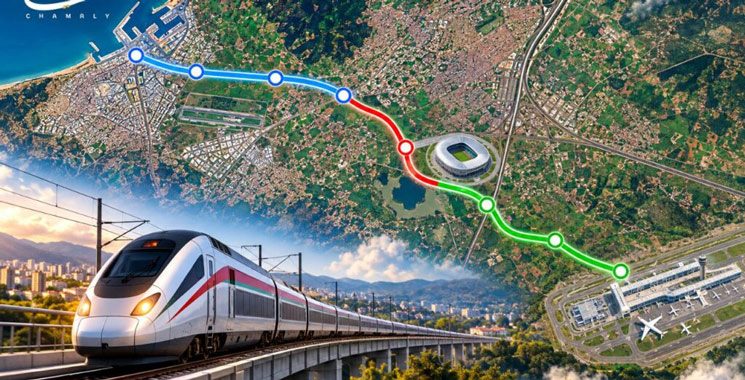
The priority is a 22.5-kilometer railway connecting Tanger Ville station with Tanger Ibn Battouta Airport, with a major stop planned at the Grand Stade Ibn Battouta.
The line is expected to become a key link between central Tanger and several rapidly developing urban and economic areas.
Its route will cross Tanger Ville, Beni Makada, Aouama and Gzenaya before reaching the airport. The project is designed as an electrified railway and will serve several strategic locations along the way.
Among the planned stops are Mghogha, Aouama, El Bharayine, the Grand Stade Ibn Battouta and the Faculties area.
The railway will also improve access to major facilities including the wholesale market and the new bus station.
For Tanger, the project comes as the metropolitan area continues to expand. Population growth, new infrastructure and increasing activity around the airport and stadium are putting additional pressure on the city’s transport network.
A direct rail connection could help shift part of these movements toward public transportation while linking several major destinations through a single corridor.
ONCF has divided the construction program into three separate packages, reflecting the very different technical conditions along the route.
The first package covers roughly 10 kilometers between Tanger Ville and kilometer point 11+500. Construction in this section will have to take place alongside existing railway infrastructure that remains in operation.
A new platform for a single track will be developed parallel to the existing Tanger-Fès railway and passenger transport infrastructure. Maintaining railway operations while integrating the new line will therefore be one of the main challenges.
The second package covers approximately 7.5 kilometers between kilometer point 10+800 and the Grand Stade at PK 18+300.
This section will include a complete double-track railway platform and will provide the main rail connection to the stadium.
The final package links the stadium to Tanger Ibn Battouta Airport over approximately six kilometers.
It is also the most distinctive engineering component of the project. The planned solution includes an elevated railway structure extending for almost the entire six-kilometer section.
The elevated alignment is intended to cross major roads and existing transport routes while reducing interference with traffic and infrastructure already in place.
The airport connection is expected to become one of the most visible benefits of the project, offering a direct rail link between central Tanger and the city’s main air gateway.
Beyond the airport, however, the broader objective is to establish the first building block of a regional rail system capable of serving the wider Tanger metropolitan area.
The launch of the prequalification process marks an important step toward turning that long-term transport vision into physical infrastructure.