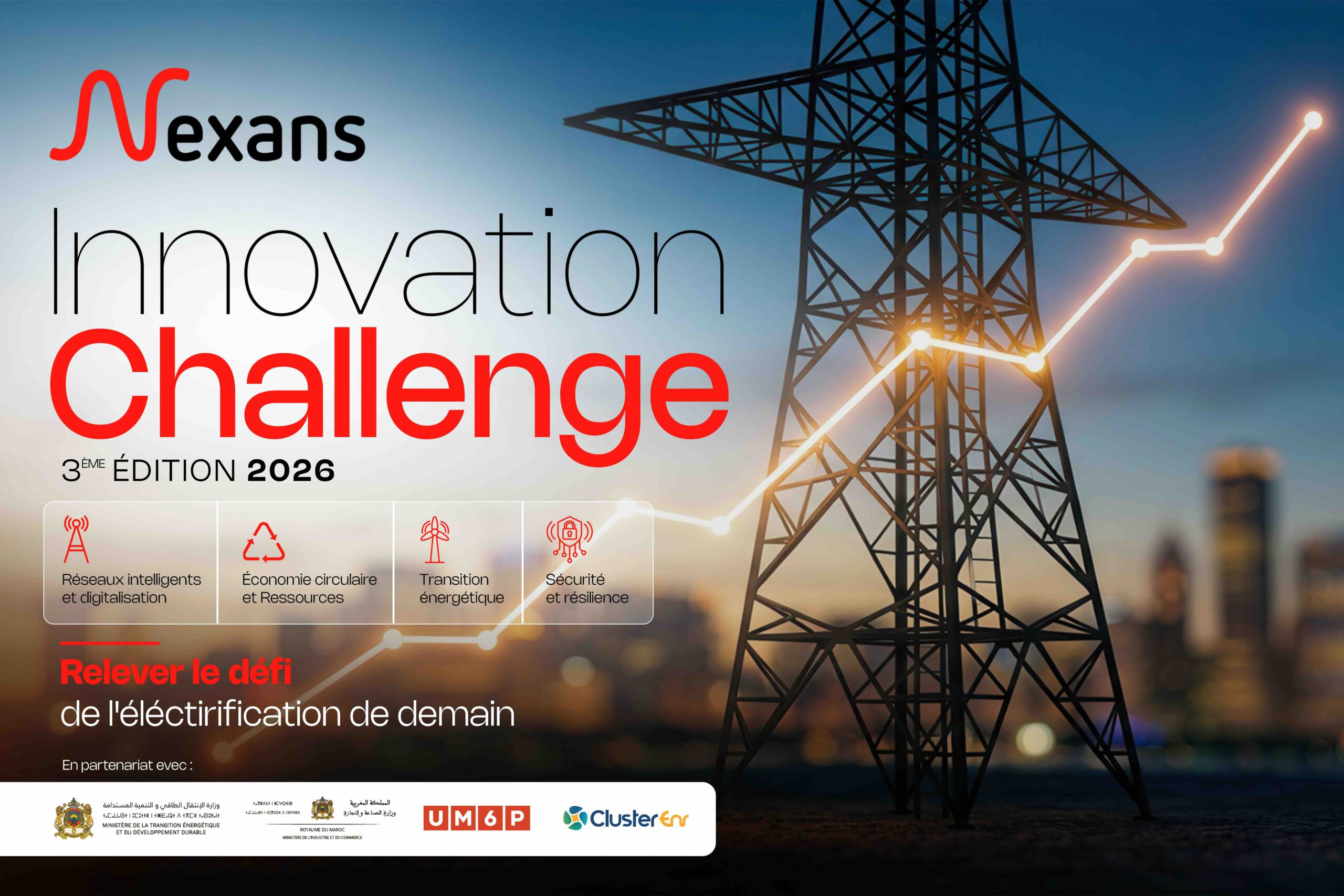
Morocco is looking to turn industrial innovation into practical solutions for its energy transition. Nexans Morocco has launched the third edition of the Nexans Innovation Challenge, an initiative designed to connect industrial needs with technologies developed by startups, researchers, universities and entrepreneurs.
The 2026 edition brings together several institutional and academic partners, including the Ministry of Industry and Trade, the Ministry of Energy, Mines and Sustainable Development, Mohammed VI Polytechnic University (UM6P) and the Renewable Energy Cluster (Cluster ENR).
The programme aims to identify solutions capable of addressing the changing demands of the electricity sector. Applicants can submit an early-stage idea, a prototype, a pilot project or an already developed technology. The focus is on innovations that can move beyond research and deliver measurable industrial value.
Four priorities define this year’s challenge. The first concerns smart grids and data, with a focus on digital networks, artificial intelligence, real-time monitoring and predictive maintenance. These technologies can help improve electricity network performance while anticipating equipment failures.
The second area targets responsible materials and the circular economy. Projects are expected to explore recycling, resource recovery, eco-design and ways to reduce the carbon footprint of industrial materials.
Energy transition forms the third pillar. Nexans is seeking solutions that accelerate renewable energy integration, particularly through solar power, energy storage and improved energy efficiency.
The fourth challenge focuses on resilient electrical infrastructure. It covers technologies designed to strengthen network reliability and safety, detect potential failures and maintain continuity of service.
For Morocco, these priorities are closely linked to the development of a more competitive industrial ecosystem. The expansion of renewable energy and the growing digitalisation of infrastructure require new technical capabilities, specialised skills and stronger links between research and industry.
Nexans Morocco says the challenge is intended to help build these capabilities. Its managing director, Amine Houssaim, sees electrification as an opportunity to develop new technologies, industrial sectors and expertise, while supporting sustainable economic growth.
Selected projects will be assessed on their originality, relevance to the four challenges, feasibility, expected impact and development potential. Winners will receive financial awards, alongside a structured support programme designed with the initiative’s partners.
This support will include technical expertise, mentoring, thematic workshops and introductions to relevant industry stakeholders. The programme is also intended to help promising projects reach a stage where industrial testing or collaboration becomes possible.
With this third edition, Nexans Morocco is seeking to strengthen the connection between innovation and industrial deployment. The ambition is not simply to reward new ideas, but to help promising technologies find practical applications in Morocco’s evolving electricity sector.