Nearly 500 activists, diplomats, political figures and civil society representatives gathered in Essaouira from November 12 to 14 for the third edition of the World Forum of Women for Peace. The international event placed women’s role in conflict resolution and peacebuilding at the center of discussions.
Organized by the Guerrières de la Paix, a movement nominated for the 2025 Nobel Peace Prize, the forum brought together participants from conflict zones and different regions of the world. Over three days, debates and personal testimonies addressed diplomacy, cultural dialogue, online hate and the involvement of younger generations in building lasting peace.
The opening ceremony took place on November 12 at Bayt Dakira. André Azoulay, Adviser to His Majesty King Mohammed VI, attended alongside Essaouira Mayor Tarik Ottmani and Abu Gosh Mayor Ibrahim Kazam. Their presence highlighted the city’s role as a meeting point for dialogue between cultures and communities.
One of the forum’s central discussions examined how culture can help shape new narratives for peace. French-Israeli singer and songwriter Yael Naim joined Moroccan painter Mohamed Mourabiti, actress and playwright Séphora Haymann, and Franco-Iranian writer and sociologist Saena Delacroix-Sadighiyan. Their exchange explored the ability of artistic expression to create connections across political and cultural divisions.
Diplomacy was another major focus. On November 13, a session on feminist diplomacy brought together former French minister and ambassador Isabelle Rome, Palestinian-Israeli activist Ghadir Hani, international criminal lawyer Céline Bardet and researcher Yasmina Asrarguis.
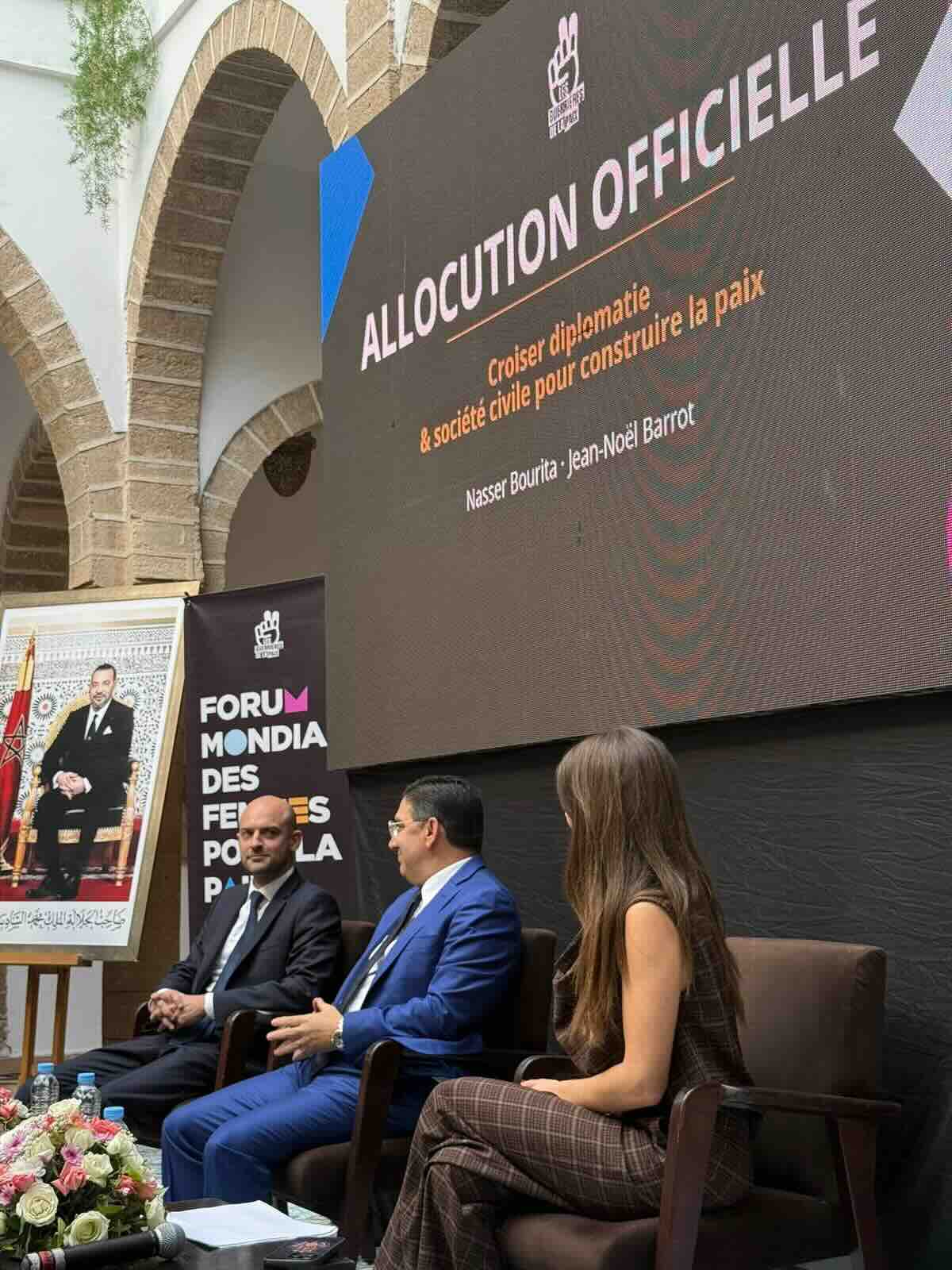
A ministerial panel at Dar Souiri brought diplomatic representatives face to face with peace activists from Palestine and Israel. Morocco’s Foreign Minister Nasser Bourita and French Foreign Minister Jean-Noël Barrot took part alongside Ali Abu Awwad, Maya Savir, Amal Abed and Yonathan Hefetz. The discussion provided an opportunity to connect official diplomatic perspectives with experiences from communities directly affected by conflict.
The programme also addressed the challenges of digital platforms, particularly the spread of online hatred. Another session focused on young people and their contribution to peace initiatives, reflecting the importance of involving new generations in efforts to prevent conflict.
Art and cinema extended the discussions beyond the conference rooms. The exhibition “Itinerary for Peace”, inaugurated at the Essaouira Bastion, brought together photographic portraits, testimonies and works by Leïla Alaoui and Gerda Hegedüs. Music and readings accompanied the exhibition, with performances involving Yael Naim and Gildaa.
The programme also included the screening of *Resisting for Peace*, directed by Hanna Assouline and Sonia Terrab, followed by *Mother’s Call*, featuring Women Wage Peace and Women of the Sun. Both projects placed personal experiences at the heart of the debate on coexistence.
The forum concluded on November 14 with the International Women’s Appeal for Peace. Activists from Sudan, Iran, Afghanistan, Morocco, Cameroon and Israel took part, including Mayada Adil, Aida Tavakoli, Fatemeh Jailani, Ghita El Khyari, Esther Omam, Naama Lazimi and Ghadir Hani.
Their appeal called on the international community to support collective efforts for peace. The closing programme also featured a musical performance by Juliata Cohen at the Essaouira Media Library.
Two publishing projects were presented during the event by Ana Mogador Editions: a first publication documenting the commitment of the Guerrières de la Paix, and *Correspondance*, a magazine highlighting social, cultural and environmental initiatives in Essaouira.