



















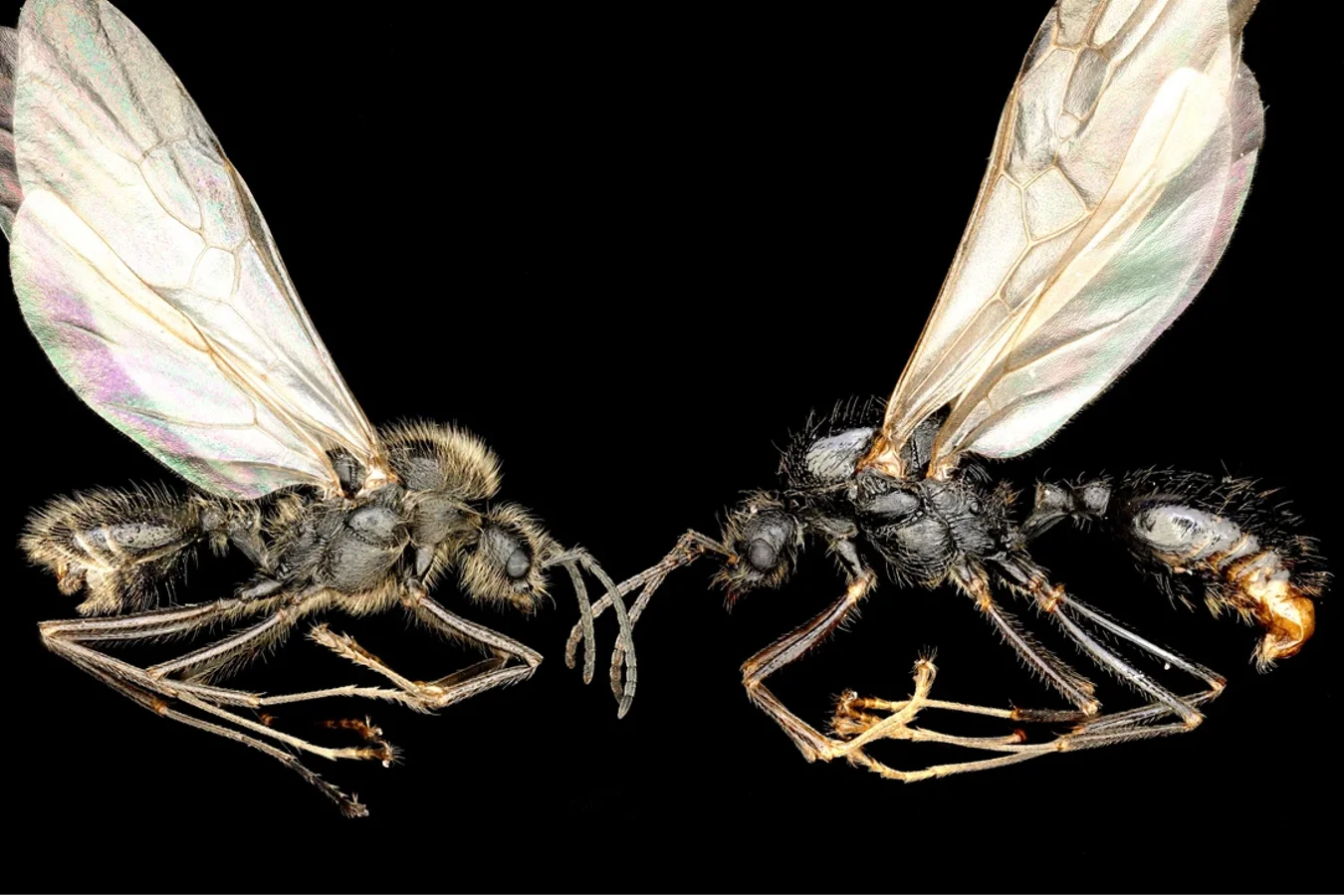
In the sun-dappled hills of Europe, a hidden drama unfolds among the smallest of creatures. The Iberian harvester ant, Messor ibericus, is rewriting the rules of biology—its queens are genetic puppeteers, orchestrating colonies with a blend of their own DNA and that of a different species.
Scientists recently uncovered that these queens are not content producing only their own kind. They exploit males of a separate species, Messor structor, to generate hybrid workers that build, forage, and maintain their colonies. Remarkably, in places like Sicily, where no M. structor males exist, M. ibericus queens resort to cloning them. Using a unique cellular trick, they produce males carrying solely M. structor DNA in their nuclei, ensuring a continued supply for future hybrid generations.
“It’s a system that seems almost unimaginable,” says evolutionary biologist Jacobus Boomsma. Indeed, it’s a phenomenon that challenges our basic understanding of reproduction. These cloned ants are essentially domesticated pawns, carrying their M. ibericus queen’s mitochondrial DNA while genetically appearing as M. structor. This dual-genome setup allows the queens to maintain control over the colony’s workforce, a strategy likened to a form of biological puppetry.
The divergence between the two species stretches back over five million years—roughly the same time humans and chimpanzees split. Yet here, one species is literally giving birth to another. When the cloned M. structor ants are introduced into a normal M. structor colony, they are recognized as invaders and swiftly eliminated. Their pheromones betray them, linking them irrevocably to the M. ibericus queens who created them.
Researchers note that this rare form of sexual parasitism is not likely to reshape evolution on a grand scale, but it offers a striking glimpse into nature’s capacity for unconventional solutions. In a way, the phenomenon mirrors the ancient incorporation of mitochondria into eukaryotic cells—a symbiotic relationship now central to life on Earth.
For now, the Iberian harvester ant queens continue their delicate balancing act, blending two species into a single functioning society. In these tiny hills and colonies, evolution’s rulebook is being rewritten one ant at a time.